

Air Ambulance Worldwide helps critically ill patients around the globe
St. Petersburg Times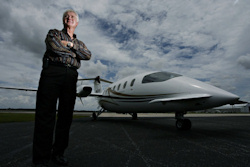
In Print: Monday, July 5, 2010
By Steve Huettel, Times Staff Writer
The phone rings and Air Ambulance Worldwide must be ready to scramble a medical evacuation flight anywhere around the globe.
Not to be confused with the helicopters that airlift accident victims to hospitals, Air Ambulance sends specially equipped planes and staff to move people under medical supervision who can’t travel otherwise.
The company makes more than 400 flights a year with its own planes at St. Petersburg-Clearwater International Airport or modified corporate aircraft on call in Atlanta, Oregon and Germany.
Air Ambulance president Mark Jones talked with the Times last week about caring for critically ill patients at 40,000 feet, who pays the five-figure bills and a new Italian turboprop, the Piaggio P180, that he expects to change the business.
What’s an example of a standard trip?
Say you call us and need to get your mother in a hospital in Fort Lauderdale to Toledo, Ohio. Our crew flies to Fort Lauderdale and an ambulance will be waiting for us at the airport. At the hospital, we’ll go to her room with the medical report prepared by our doctor and meet with the nurse responsible for her care. Once we touch her hand, we don’t let go until she’s in her bed in Toledo.
What kind of medical professionals accompany the patient?
At least two medical staff on board: usually a combination of nurses, respiratory therapists and paramedics, depending on the patient’s situation. In Europe, you must have a doctor. We have three that work for us.
How serious a medical emergency can you handle in the air?
Almost anything they can do in an emergency room. Under the stretcher is an oxygen tank with a 10-hour supply. The stretcher has an electrical system you can plug into. There’s suction, compressed air, a pacemaker, defibrillator, ventilator, a heart monitor that shows all the vital signs. We can administer upwards of six or eight (intravenous tubes), medications and morphine.
What if a patient is in danger of dying during a flight?
If there’s a (do-not-resuscitate order) we will not save their lives, just make them comfortable. If not … we’ll call for an emergency landing at the next airport. Before we touch down, there will be an ambulance there to take them to the hospital.
Does it happen often?
No. Maybe once or twice a year.
Are most of your patients in life-threatening situations?
A majority of our flights are for people who are bedridden or injured or too sick to sit up. It ranges from frail, elderly people to healthy people with broken arms and legs — car accidents. This week, we did a Cozumel-to-Miami flight — a cruise ship passenger who had heart failure and was in the infirmary. We had to get there before 6 p.m., when the ship left port. They didn’t want to put him in a hospital there.
Where does most of your business come from?
Only about 15 percent of our calls are from individuals. People buy travel insurance … and when someone breaks a hip in Paris, they call to have the insurance get them home. They talk to a “travel assist company.” The assist company has to get three bids, and they call us for a quote. We have 30 minutes to an hour and a half to respond. They typically want to go in the next two to five hours. Most of the time we can make that happen.
How much does a flight cost?
From here to the Northeast is $15,000 to $17,000. Cross-country is $25,000 to $28,000. You pay for the flight up and back.
Why do you like the Piaggio so much?
If I had a Learjet like everyone else, I’d be an also-ran. The Learjet has 250 cubic feet (of cabin space); the Piaggio has 375. If you fly on a Learjet you can take a passenger (plus the patient and medical staff) with room for a small duffle bag. The Piaggio can take three passengers, a wheelchair and three or four suitcases. The Learjet flies 450 mph to 500 mph, the Piaggio 450 mph. But the Learjet burns 198 gallons of fuel per hour. The Piaggio: 92 gallons. We say it’s a turboprop that thinks it’s a jet.
Steve Huettel can be reached at huettel@sptimes.com or (813) 226-384. – Original article